 Strength training
A 20-Minute Dumbbell Workout With Rest Included
Follow an honest 20-minute dumbbell session: a full timeline with warm-up, seven exercise slots, rest, transitions, and an easier option.
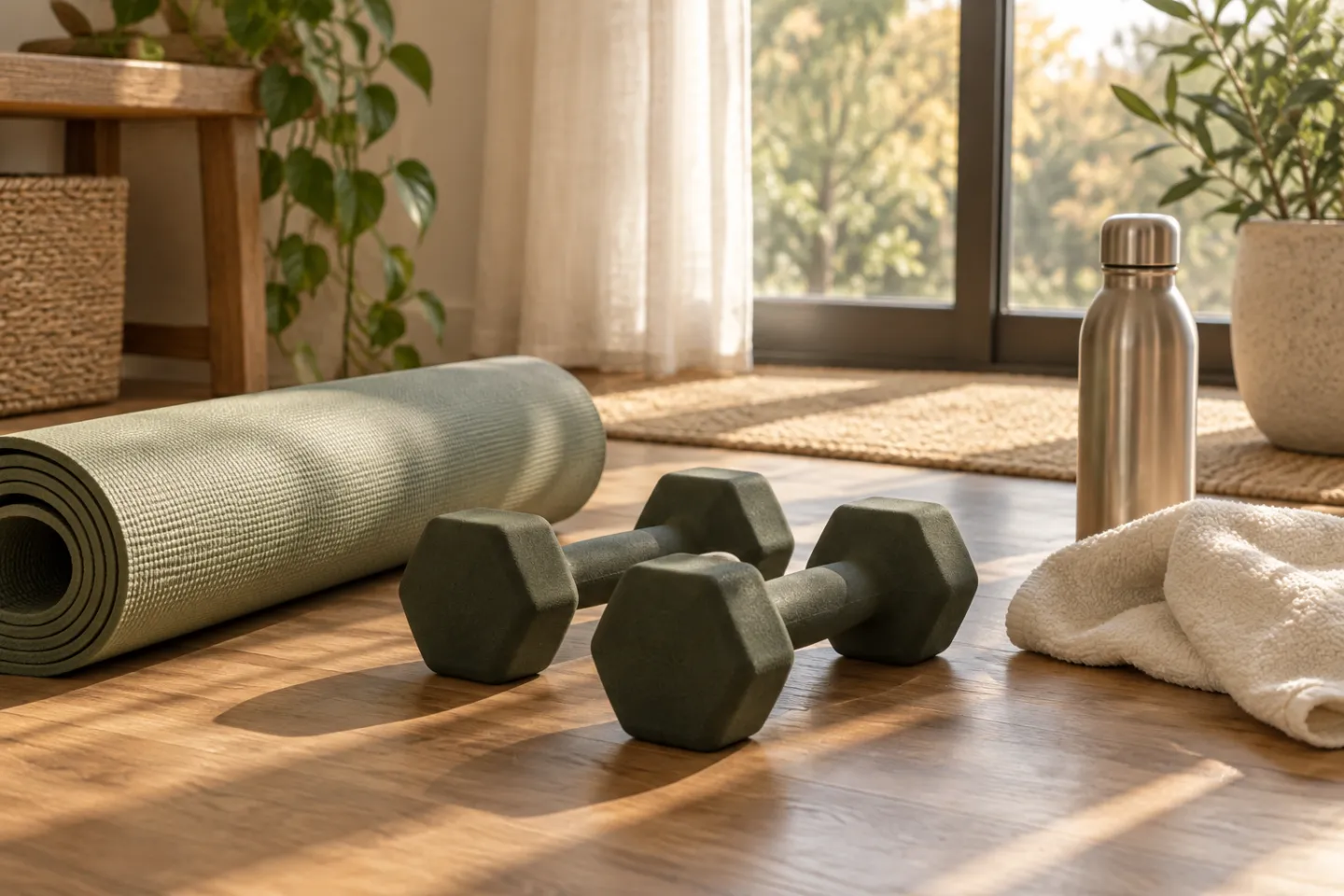
A 20-minute dumbbell workout needs a time budget that includes rest and changing positions. This example uses three minutes to warm up, seven two-minute exercise slots, and three minutes to finish: 3 + 14 + 3 = 20 minutes. You perform one controlled set in each exercise slot, not two minutes of continuous lifting.
This original short session is for generally healthy adults who already know the movements and have suitable weights ready. It is a brief strength practice, not a complete weekly program or a maximal-effort circuit. Learn unfamiliar exercises separately before trying to fit them to a clock.
Prepare before starting the timer
Clear the floor, check that the dumbbells are secure, and put the exercise list where you can see it. Use a stable support surface for the row and make enough space for a floor press. Choose loads that let you finish each set with several controlled repetitions still possible. Different exercises can use different weights.
This setup happens before the advertised session, like putting on workout clothes. If equipment changes take longer than the rest allowance, simplify the equipment or skip a later set. The timer should help you leave on time, not pressure you into handling weights carelessly.
Follow the full 20-minute timeline
Each two-minute exercise slot includes one set lasting roughly 20–40 seconds, followed by 80–100 seconds for recovery and the next setup. About six to ten steady repetitions may fit, depending on the exercise and your pace, but there is no requirement to fill the work window. Stop earlier when technique changes.
The left and right row each have their own slot, so switching sides is not hidden outside the schedule. Read the entire timeline first and keep transitions unhurried.
| Clock | Task | Rest and transition included |
|---|---|---|
| 0:00–3:00 | Easy marching or walking; rehearse squat and hinge without weights | Use this time to move gradually and check comfort |
| 3:00–5:00 | One set of goblet squats | Rest after the set and prepare for the hinge |
| 5:00–7:00 | One set of dumbbell Romanian deadlifts | Rest and move to the row support |
| 7:00–9:00 | One set of supported rows, left arm | Rest and set up the other side |
| 9:00–11:00 | One set of supported rows, right arm | Rest and prepare the floor-press position |
| 11:00–13:00 | One set of dumbbell floor presses | Rest; put weights down safely and stand up |
| 13:00–15:00 | One set of standing dumbbell curls | Rest and move beside balance support |
| 15:00–17:00 | One set of calf raises, bodyweight or manageable dumbbells | Rest and put equipment safely aside |
| 17:00–20:00 | Easy walking or relaxed movement; record the session | Finish calmly and note any changes for next time |
Use the timer as a limit, not a speed target
Start a set only when you can breathe comfortably and control the starting position. If you are not ready at the beginning of a slot, keep resting. You may perform a shorter set later in that slot or leave it out. Do not repay the missed repetitions by rushing the next movement.
A short session works best when the exercises are familiar. This is not a contest to complete as many repetitions as possible. The long rest and setup allowance is intentional: an article that lists twenty minutes of work plus uncounted recovery is describing a longer workout.
Make it easier without breaking the schedule
Keep the same clock and replace the goblet squat with a comfortable unweighted sit-to-stand, the deadlift with an unloaded hinge, or the floor press with a wall push-up. Use bodyweight calf raises beside stable support. If a row setup remains unfamiliar, omit that slot and arrange instruction before your next attempt.
Do not assume the same dumbbell is suitable for squats, rows, presses, and curls. Use a lighter choice where needed. If safe floor access takes extra time, perform the wall version instead. Changing the exercise deliberately preserves the purpose of the session better than forcing an awkward transition.
Place this session within your week
This example is time-limited and does not claim to cover every training goal. CDC describes aerobic activity and strengthening as separate parts of an active week; twenty minutes with dumbbells does not automatically count as twenty minutes of moderate aerobic exercise. Add suitable walking or other aerobic activity separately.
ACSM’s current guidance allows individualized resistance routines. Use the short session when it matches your schedule, and a fuller program when you need more practice or training volume. There is no guaranteed calorie burn or specific body-composition result attached to completing this timer.
Keep a one-minute record you can use
During the final easy period, record the load and repetitions for each exercise, any omitted slot, and whether the transitions fit. Next time, fix the biggest practical problem first. An awkward row support or difficult weight change is more useful information than a vague “good workout” label.
If time ran short, keep the twenty-minute boundary and accept the shorter exercise list. If pain, dizziness, chest discomfort, or unusual breathlessness occurs, stop; reaching the final timestamp is not the priority. Repeatability and control matter more than satisfying every row of the table.
Sources & further reading
- CDC: What counts as physical activity
- ACSM: 2026 resistance training guidelines
- NHS: Illustrated strength exercises
Published by the Autumn team on . Have a correction or a question? Get in touch.